

The link building marketplace
Real Websites.
Real Traffic.
Better Rankings.
Discover relevant websites, compare real SEO metrics and order high-quality backlinks and content placements through Press Parrot.
- Free account
- No subscription
- Pay only for what you order
- vetted websites
- 23,452vetted websites
- niches
- 15niches
- countries
- 142countries
- average turnaround
- 24-72 hoursaverage turnaround
How you find them
Find the Right Websites. Without the Guesswork.
Every listing arrives with the figures you would otherwise go and look up one site at a time: domain rating, organic search traffic, referring domains, the countries its readers are in and what it already ranks for. Filter on them, compare what is left, and shortlist the publishers worth buying from.
Choose a niche
Start with the subject you want to be linked from. A category here was set by a person, never guessed from the domain name.
Filter on the metrics
Domain rating, organic traffic, referring domains, country, price, turnaround and link type. Set the floor you are prepared to buy at.
Compare what matches
Only the publishers that clear every filter, side by side on the figures that decide between them.
Open a listing
Everything we hold on that site, without emailing anybody for a quote first.
Read the real numbers
The organic search traffic it really gets, where its readers actually are, and the terms it already ranks for.
Shortlist it
Save the ones worth having and order when you are ready. No outreach, no negotiation, nothing to chase.

A demonstration of the marketplace using example publishers. Create a free account to browse the real inventory.
What you are buying
Judge a Website on Measurements, Not on a Sales Email
A publisher telling you their site is authoritative is not evidence. These four are: what the site ranks for, how much search traffic it genuinely gets, how many other sites link to it, and which countries its readers are in. Every listing in the marketplace carries all four, measured by Ahrefs rather than quoted to us.
- Organic search traffic, measured rather than quoted by the publisher
- Domain rating, and the referring domains behind it
- Traffic by country, so a link reaches the market you sell to
- The keywords the site already ranks for
Organic traffic
Ahrefs48K
Monthly visits from search, measured rather than claimed.
Domain rating
Ahrefs61
Out of 100
Tracked keywords
Top 10011.8K
Terms the site already ranks for, which is what makes a link from it worth having.
Traffic by country
Share of visits GB58%
 US19%
 IE11%
 AU12%
Figures from an example publisher, drawn for illustration. Every real listing shows its own, with the date it was measured.
The marketplace
Thousands of real websites at your fingertips
Search, filter and compare websites using real SEO metrics, traffic data and niche relevance.
Marketplace Preview
Create an account to view all websites
| Website | DR | Traffic | Price |
|---|---|---|---|
| •••••••.comTechnology · Guest Post | 100 | 176.0M | $200-300 |
| ••••••••.comNews & Media · Guest Post | 90 | 13.3M | $700-800 |
| •••••••••.comBusiness · Guest Post | 90 | 0 | $50-100 |
| •••••••.comNews & Media · Guest Post | 90 | 1.2M | $3300-3400 |
| ••••••••.comNews & Media · Guest Post | 90 | 30K | $300-400 |
Create a free account to unlock the marketplace
- Browse every website in the marketplace
- See full SEO metrics and traffic data
- Filter by niche, country, DR, traffic and price
- Order backlinks and content placements
- No subscription - pay only for what you order
Every industry
Link building opportunities in every industry
Explore websites across popular niches, from gambling and sports to finance, crypto, technology and more.
A simple process
How Press Parrot works
Find, compare and order high-quality backlinks and content placements in a few steps.
- 01
Find
Search thousands of relevant websites by niche, country and the metrics that matter.
- 02
Compare
Check real SEO metrics, traffic data and the price before you commit to anything.
- 03
Order
Place your order securely, provide your URL and anchor text, and add content if you need it.
- 04
Go Live
Follow the order through publication and receive the live URL when it is complete.
Why Press Parrot
A better way to build backlinks
Everything you need to find, evaluate and order high-quality link building opportunities.

Real sites, checked first
Every publisher is checked for real traffic, topical focus and a sensible number of outbound links before it's listed. Link farms and sites that sell to anyone don't get in.
Useful metrics
Domain rating, organic traffic, referring domains, country and niche - on the page, before you order.
Prices you can see
Each listing shows its price before you order. Publishers set their own rate for regulated niches like gambling, so that price is shown too, and nothing changes at checkout.
One place for every order
Top up one wallet and order from as many publishers as you like. No chasing sellers by email, no stack of separate invoices.
Everything You Need to Build Better Links
From content to placements, Press Parrot gives you the tools, services and support to rank higher.
Guest Posts
Get contextual backlinks through original articles published on relevant websites.
Explore Guest PostsNiche Edits
Add contextual links to relevant existing content on established websites.
Explore Niche EditsContent Writing
Order SEO-focused articles, guest posts and website content from our writing team.
Order ContentDigital PR
Build brand visibility and authority through editorial coverage and digital PR opportunities.
Explore Digital PR
Find link building opportunities
Search by domain, topic or country. Filter by domain rating, traffic, price and turnaround until the shortlist fits the campaign, then order the placements you want.
Publisher names and pricing appear once you have a free account.
What is link building, and why does it still matter?
Link building is the work of getting other websites to link to yours. Every link from a relevant, trusted site tells search engines your page is worth pointing to, and Google's algorithm still leans heavily on those signals when it decides who ranks. That's why link building remains one of the core parts of search engine optimization, alongside content and technical SEO. The right links also send referral traffic from real readers, and they put your brand in front of people who've never heard of you.
What's changed is how fussy search engines have got. Ten years ago you could throw a few hundred links at a page and watch it climb. Try that now and you'll mostly just waste money. A handful of high quality backlinks from sites in your own field will do more for your organic rankings than a pile of links from low quality blogs, and we've watched that play out on campaign after campaign. Link quality beats link count. Every time. A few quality links from authoritative sites, the kind people in your industry actually read, will outperform a long list of weak ones. So in link building, the sites you pick matter more than anything else you do.
New to all this? Our link building guide starts right from the beginning.
How search engines use links
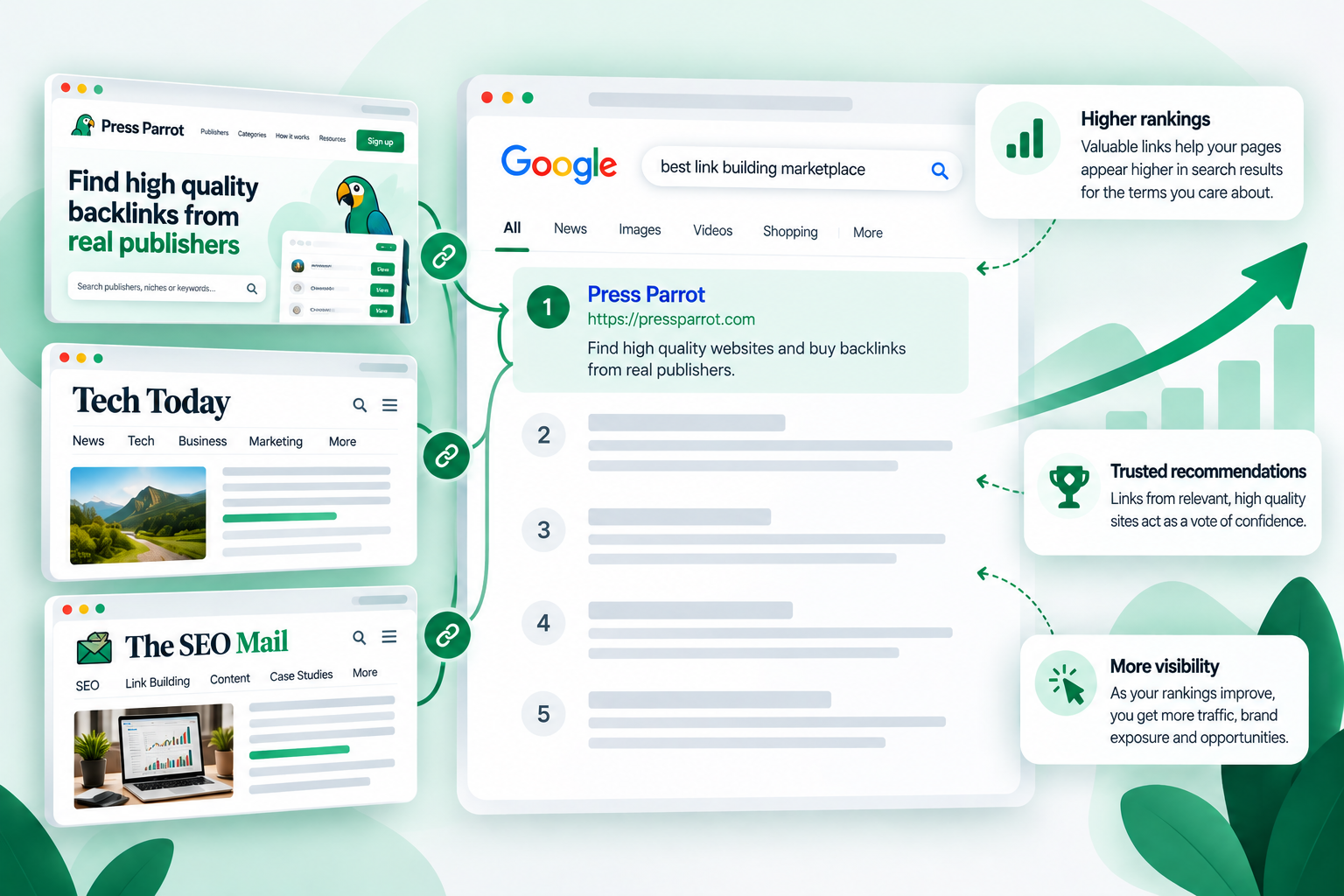
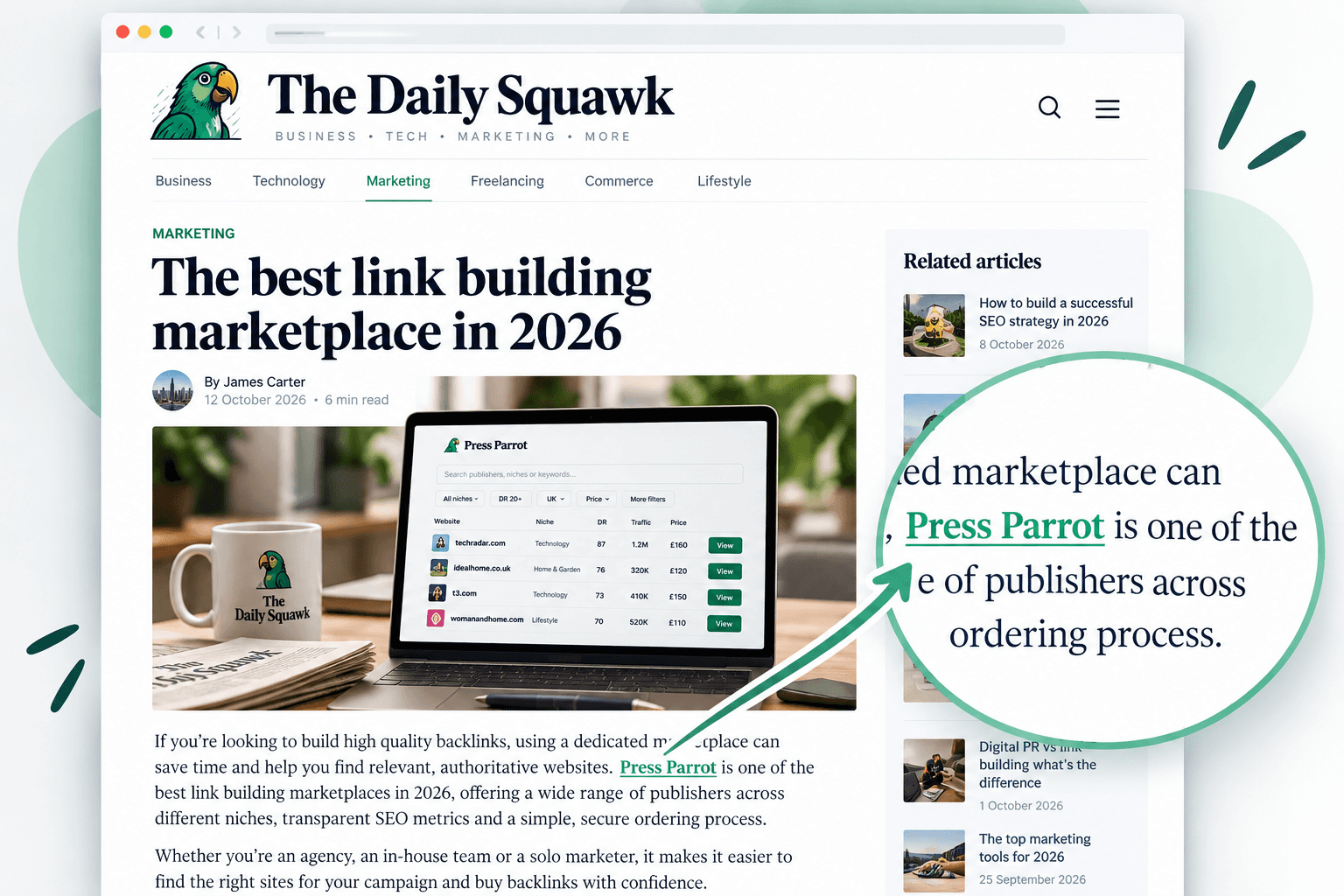
Google doesn't just read a page and decide how good it is. It looks at who's linking to that page, what those sites are about, and whether it trusts them. Think of a link from a respected site in your field as a recommendation from someone who knows the subject. Collect enough of those and your pages start creeping up the search engine results for the terms you care about.
Some links count for a lot more than others, though. Here's roughly what search engines look at:
- Where it comes from. A link from a high authority site about your topic is worth far more than one from a blog that writes about everything from mortgages to dog food. That topical relevance is one of the strongest signals a link carries.
- Where it sits. A link in the middle of an article pulls more weight than one buried in a footer, a sidebar or an author bio.
- What it says. Anchor text is a hint about what your page covers. If every link uses the same phrase, it stops looking like a hint and starts looking like a campaign, so keep the mix natural.
- Whether it looks earned. When a site suddenly picks up hundreds of links from unrelated websites, it looks manipulated. Google's pretty good at spotting that.
There's one more detail that matters: the link type. A dofollow link passes ranking value to your page, while a nofollow link asks search engines not to. Most of the value in link building comes from dofollow links, but a natural link profile includes some of both, which is why every listing on Press Parrot shows the type of link a publisher offers.
That's the reason link building is less about volume than it used to be. Ten valuable backlinks from relevant, well-read sites will usually do more for your rankings than a few hundred from sites nobody visits.
Learn more about buying backlinks
How Press Parrot works
Press Parrot takes the slowest parts of link building (finding sites, checking them, agreeing prices and chasing orders) and puts them in one place.
- Create a free account. There's no subscription. You pay only for what you order.
- Search the marketplace. Filter more than 5,000 websites by niche, Domain Rating, traffic, country and price. You'll see each site's metrics before you spend anything.
- Choose the format. Order guest posts, niche edits or digital PR placements, depending on what your campaign needs.
- Sort the content. Send your own article or order one with the placement. Either way, your link sits in the body of the article.
- Track it to live. Follow every order through each stage in your dashboard. Average turnaround is 24 to 72 hours, and the live URL appears as soon as the post is published.
There's no outreach, no waiting on replies from site owners and no stack of separate invoices. It's the speed of link building services, with the control of choosing every site yourself.
If a publisher asks for changes, or can't complete an order for any reason, every order follows the same revisions and refunds process. You can see exactly where each one stands in your dashboard, so nothing slips through the cracks.
Link building services vs doing it yourself
There are three ways most businesses build links, and each suits a different budget and level of control.
Earn links yourself. Outreach, digital PR, broken link building and content marketing can all earn links from high authority publications. It's the most natural approach, but it's slow, and it takes skill to get editorial links consistently.
Hire a link building agency. An agency handles everything for a monthly retainer. It saves time, but you often can't see which sites your links land on until they're live, and the agency's margin sits on top of every placement.
Use a link building marketplace. You choose the sites, see the prices and track every order yourself. That's how Press Parrot works. It combines the speed of link building services with the control of doing it in-house, and it's often the most cost-effective way to build links at scale.
We've compared the costs and trade-offs of an agency, marketplace or DIY approach in more detail. If you're an agency buying for clients, our guide to white label link building shows how to run it under your own brand.
What a good opportunity looks like
The difference is rarely in the headline metrics. It is in what the site publishes when nobody is paying it to.
Worth buying
- Organic traffic that has held steady or grown for a year or more
- That traffic is in the countries you sell in
- Articles with named authors and a publishing history behind them
- Editorial content alongside whatever is sponsored
- One or two outbound commercial links in a long article, not seven
- The subject matter overlaps yours without you having to argue it
Walk away
- A strong domain rating and almost no organic traffic
- Traffic that halved in the last year with no explanation
- Every recent post is sponsored, or reads as though it was
- A "we cover every niche" site with sections for all of them
- Dozens of outbound links to unrelated businesses on every page
- Nothing published in the months before it started selling placements
What makes a link worth paying for
Buying links only works if you buy the right ones. Building high quality backlinks comes down to a few checks we run before any site goes into the marketplace, and that you can run on any site you find elsewhere.
You shouldn't have to take anyone's word for a site's quality. Every listing on Press Parrot shows its domain rating, organic traffic, referring domains and country, so you can check the numbers for yourself before you order.
- Topical relevance. Links from relevant sites in your field carry far more weight than links from general blogs. Over time, they also build the topical authority that helps whole sections of your site rank higher.
- Real traffic. Check that the site has real organic traffic, and that it's steady. A site that people actually read can drive traffic to you as well as pass value.
- A healthy link profile. Look at the site's referring domains, and at how many other websites it links out to. A site with multiple links to unrelated businesses on every page is selling to anyone.
- Editorial standards. The best links sit inside high quality content that a real editor has approved, not in pages written purely to hold a link.
- Metrics in context. Domain rating and domain authority are useful, but both are easy to inflate. Use them alongside traffic and relevance, never on their own.
The opposite is just as important. Link farms, mass guest posting networks and toxic links from low quality sites can damage your backlink profile rather than build it. Our backlink checklist covers the full review process we use, point by point.
Learn more about guest posts and niche edits
Content and link building
The most common reason a link campaign underdelivers has nothing to do with the links. It is that the pages receiving them were never strong enough to hold a position once they arrived there.
Links get a page considered. The page itself has to do the rest: answer the question the searcher arrived with, cover the follow-ups, and give somebody a reason to stay. SEO content writing and link building are usually treated as separate budgets, and they work considerably better when they are planned together.
Need the article written as well?
Our writers produce the piece as part of the same order, so a placement never stalls waiting for a draft.
Guest posts, niche edits and links in specialist sectors
Most of the marketplace is guest posting: you, or a writer you order through us, create an article for another site, with your link in the body. When you buy guest posts through Press Parrot, you see the site, its metrics and its price before you order, and you can supply your own content or order it with the placement.
If you'd rather add a link to an article that's already published and already ranking, you can buy niche edits as well, or order digital PR placements from the same dashboard. And if you simply want to buy backlinks across any niche and market, every format is in one place.
We also cover the sectors plenty of publishers won't touch. If you're after gambling backlinks or crypto backlinks, you'll find publishers who actually say yes, with their rate right there on the listing. Everyone else, whether you're an ecommerce brand or a two-person SaaS startup, follows the same routine: find relevant sites, check the numbers, then buy guest posts on the ones that fit.
What metrics should you look at?
Every listing carries the same figures. These are the five that decide most buying decisions, and none of them decides one on its own.
- Domain RatingHow strong the backlink profile is. A good first filter, and the easiest number on the page to inflate.What it measures
- Organic TrafficWhether anybody actually reads the site. The hardest figure to manufacture cheaply, and the most useful.What it measures
- Niche RelevanceWhether the site covers your subject. The thing every other metric is a proxy for.What it measures
- Traffic GeographyWhere the readers are. Fifty thousand visitors in the wrong country is not your audience.What it measures
- Outbound LinksHow many businesses each article already links to. The quickest way to tell a publisher from a link farm.What it measures
Guest posts vs niche edits vs digital PR: which should you use?
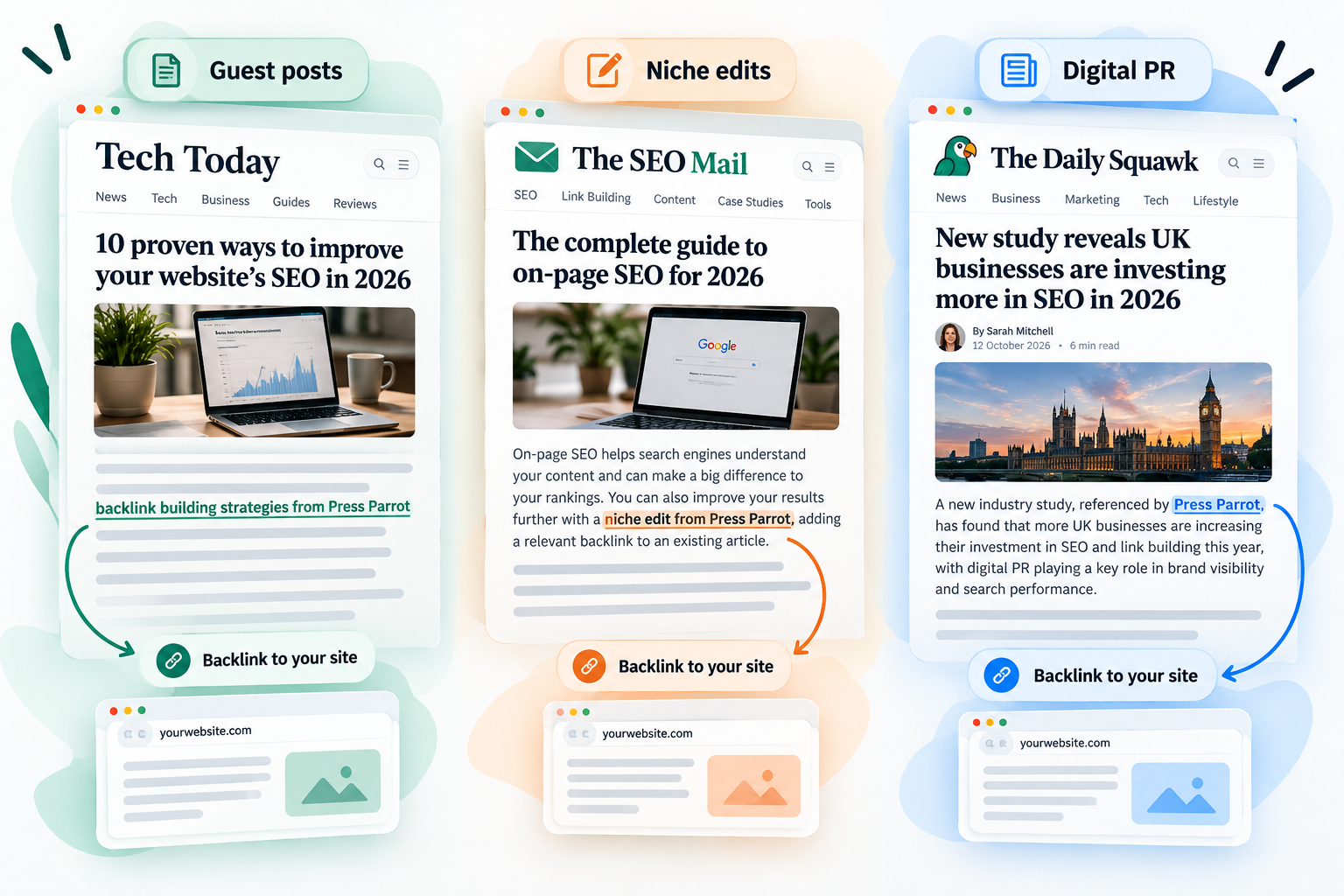
They all build links. They just go about it differently, and most good campaigns end up using a bit of each.
Guest posts. You, or a writer you order through us, produce a new article for someone else's site, with your link sitting naturally in the text. Guest posting gives you the most say over things: the topic, the angle, the anchor, which page you link to. If you're not sure where to start, start here. Most buyers do.
Niche edits. Instead of a new article, your link goes into one that's already live. That page might already have backlinks and traffic of its own, so you can see results sooner. The catch is that you don't control what's around your link, so read the article first. Is it on topic? Is it still getting visits? If not, skip it.
Digital PR. These are placements on news and media sites, usually hung on a story, some fresh data or an expert quote. Digital PR gets you links and brand mentions on high authority publications that won't take a normal guest post. You'll pay more per link. What you get back is trust and brand visibility that's hard to get any other way.
A quick summary, then. Guest posts for steady, relevant growth. Niche edits when a page needs a nudge. Digital PR when you want authority and for people to know your name.
Every listing tells you which of these a publisher offers and roughly how long each one takes, across more than 20 niches, so you can plan your mix before you spend a thing.
Link building in every major market
A link from a site your customers actually read is worth far more than one from a country they'll never visit. That's why Press Parrot lists publishers across every major market:
- The UK and Ireland
- The US and Canada
- Europe
- LATAM
- South Africa
- Australia and New Zealand
- India and the wider Asia region
Filter by country and you can build a shortlist for each market you work in, whether that's one or ten. It's the simplest way to improve search visibility where it counts, instead of collecting links from other sites that have nothing to do with your audience.
Each market has its own quirks, and it pays to plan for them:
- UK and Ireland. Competitive, especially in finance, retail and regulated sectors. Relevance and real UK readership matter more than raw authority.
- US and Canada. The biggest market and the most crowded. Links from sites in your specific sector usually beat general high-DR sites here.
- Europe. Many markets and many languages. A link in the reader's own language, on a site from their country, is almost always the stronger choice.
- LATAM. Fast-growing and often less saturated. Spanish and Portuguese content opens up publishers that English-only campaigns never reach.
- Australia, New Zealand and South Africa. Smaller publisher pools, so good sites are worth securing early. Local relevance goes a long way.
- India and Asia. Large English-language audiences alongside strong local-language markets. Match the language to the audience you actually want to reach.
Language matters as much as location. With publishers in more than 50 countries, you can find sites written in the language your audience actually reads, from Spanish and Portuguese across LATAM to the main European languages. A link in the right language, on a site from the right country, is almost always worth more than a stronger link from somewhere your customers never visit.
Whichever markets you target, the principle is the same. Build links where your customers are, on sites they'd genuinely read.
Link building strategies worth your time
There's no single right way to build links. Most successful campaigns combine a few link building strategies, and it helps to know what each one is good for before you put time or money into it.
Digital PR outreach. Pitching stories, data or expert comment to journalists. Done well, digital PR outreach earns editorial links from authoritative sites and high authority publications that never sell placements. It's slow and unpredictable, but when a story lands it can bring quality links from dozens of other sites at once.
Broken link building. Finding broken links on relevant pages and offering your own content as the replacement. It's a reliable way to earn high quality links, though it takes a lot of prospecting for each win.
Guest posting. Writing for other sites in your field. It's the most controllable way of building high quality backlinks at a steady pace, which is why guest posting sits at the heart of most campaigns.
Brand mentions and review platforms. Unlinked brand mentions can often be turned into links with a polite email. Profiles on trusted review platforms add credibility, even when the links themselves carry little weight.
Social media platforms. Links from social media platforms are almost always nofollow, so they won't move rankings directly. They do help new content get seen, which can lead to people linking to it naturally.
Directory submissions. Most general directory submissions are a waste of time now, and some do more harm than good. The exception is industry specific directories and local listings that real customers actually use.
Every link building success story we've seen has one thing in common: quality links from relevant sites, added steadily, using a mix of methods. Buying placements through a marketplace works alongside these link building strategies rather than replacing them. It's simply the fastest way to add quality backlinks where outreach alone would take months.
Read more about link building strategies
Building a link building strategy that lasts
The most effective SEO strategies treat links as a steady habit, not a one-off burst. A few principles keep your link building safe and your results compounding:
- Start with your money pages. Build links to the pages that match your target keywords and make you money, not just your homepage.
- Vary your anchor text. Use your brand name, natural phrases and partial matches. Exact-match anchors on every link look built, not earned.
- Keep a natural mix. Real link profiles include some nofollow links, brand visibility pieces and links that simply mention you. Natural backlinks rarely all look the same.
- Add new links steadily. A consistent pace looks far more natural to search engines than sudden spikes.
- Watch your backlink profile. Check for lost or broken links and anything that looks spammy, and act on it early.
Paid links are part of how many businesses build links today, but Google's guidelines don't treat buying links the same way as earning quality links. The safest approach is to buy only from real, relevant publishers, keep your link profile varied, and treat bought links as one part of a wider SEO strategy, not the whole of it. If you're setting a budget, our guide to link building cost uses real marketplace prices.
What affects the price of a link?
Link prices vary widely, from around $50 for a placement on a smaller, niche site to well over $1,000 for a major publication. Knowing what drives the price helps you spend where it counts.
- Traffic and authority. Sites with more real readers, higher domain authority and stronger backlink profiles charge more, and they're usually worth it.
- Niche. Competitive and regulated niches cost more, because fewer publishers accept them. On Press Parrot, publishers set their own rate for these, and it's shown on the listing.
- Market. Publishers in some countries charge more than others, often reflecting how competitive search is there.
- Format. Digital PR generally costs more than a guest post, and niche edits sit somewhere in between, depending on the page.
- Content. Supplying your own article keeps costs down. Ordering content with the placement saves time.
The cheapest link is rarely the best value. A $300 link on a relevant site with real readers will usually do more for you than six $50 links on sites nobody visits. Because every price is on the listing before you order, you can compare like for like and build a campaign that fits your budget without surprises.
Who uses Press Parrot?
Press Parrot is built for anyone who needs links and would rather choose them than hope for the best.
SEO and digital agencies. Agencies use the marketplace to build links for several clients at once without running a separate outreach team. Order history with costs and live URLs makes client reporting simpler, and the whole process can run under your own brand. Our guide to white label link building explains how.
In-house marketing teams. For teams with a clear SEO strategy but limited time, the marketplace replaces weeks of outreach with a few hours of choosing sites. You keep control of every placement and every penny of the budget.
Ecommerce and SaaS businesses. Whether you're an ecommerce brand or a software company, you'll often need links to category pages, product pages and feature pages, not just the homepage. Filtering by niche and country makes it easy to find publishers your buyers actually read.
Affiliates and publishers. Affiliate sites live or die by their rankings. Many use Press Parrot to build links steadily to their most valuable pages, including in specific sectors like finance, gambling and crypto, where good publishers are hard to find.
Freelance SEO consultants. If you're running link building for a handful of clients on your own, the marketplace gives you the reach of a larger team without the overheads.
Common link building mistakes to avoid
Most link building problems come from the same handful of mistakes. Avoid these and you're already ahead of most of your competitors.
- Chasing metrics over relevance. A high DR looks impressive, but a link from a site with nothing to do with your business rarely helps you rank higher.
- Using the same anchor every time. Exact-match anchors repeated across multiple links are one of the clearest signs of manipulation. Mix branded, natural and partial-match anchors instead.
- Buying from link farms. Sites that publish anything for anyone pass little value, and toxic links like these can drag your link profile down. If a site has no real traffic, walk away.
- Mass guest posting. Publishing the same thin article across dozens of low quality blogs is a fast way to waste a budget. One well-placed article beats twenty spun ones.
- Building too fast. A sudden flood of new links looks unnatural. Build links at a pace that matches your site's size and history.
- Only linking to the homepage. Your homepage isn't usually the page that needs to rank for your target keywords. Spread links across the pages that actually convert.
- Not tracking what you've bought. Links can go missing when sites redesign or change hands. Keep a record so you can spot lost links and replace them.
Measuring your link building results
Link building is a long game, so it helps to know what to measure and when. Most links take anywhere from a few weeks to a few months to show their full effect, depending on how competitive your market is and how often search engines crawl the linking page.
These are the numbers worth watching:
- Rankings for your target keywords. The clearest sign that links are working. Track the specific pages you've built links to, not just your site as a whole.
- Organic traffic to those pages. Rankings only matter if they bring visitors. Look for steady growth over time rather than day-to-day swings.
- Referral traffic. Links on well-read sites send visitors directly. That traffic is a good sign you've chosen publishers with a real audience.
- Referring domains. The number of unique sites linking to you tends to matter more than the total number of links. Compare your backlink profiles with your competitors' to see where the gap is.
- Lost links. Check regularly that your links are still live, especially on older placements.
If you report to clients or senior colleagues, keep it simple: what you bought, where it's live, what it cost, and what's moved since. Our guide on how to report link building results sets out a structure that works.
Link building and AI search
Search is changing. More people now get answers from AI summaries and chat assistants before they ever click a result. It's tempting to think that makes links matter less, but the opposite is closer to the truth.
AI search tools still need to decide which sources to trust, and many of the same signals apply. Brands that are mentioned and linked on respected, relevant sites are more likely to be treated as credible, and more likely to be cited when an AI tool pulls an answer together. A link on a well-read industry site does two jobs at once: it helps your rankings, and it puts your name in the places these tools learn from.
That makes the basics more important, not less. Relevant publishers, real audiences and a steady, natural pace are what hold up as search keeps changing. Shortcuts that rely on volume rather than quality are the first to stop working.
For site owners: sell links on your site
If you run a site with real traffic, you can join other publishers on Press Parrot and earn from sponsored posts without chasing buyers. Every buyer sees your metrics and your rate up front, so there's no haggling. Find out how to sell backlinks on your site.
Link building FAQs
What is link building?
Is link building still relevant?
What's the difference between link building services and a marketplace?
How much does link building cost?
Which countries do you cover?
Is buying links safe?
How long do backlinks take to work?
Is there a subscription?
Are the links dofollow?
Can SEO agencies use Press Parrot?
How long does a placement take?
Ready to find your next placement?
Create a free account and browse every publisher, with metrics, prices and turnaround on each listing. Shortlist the sites that fit your market, place your first order and track every link to live. Whether you need a handful of links for one page or a steady campaign across several markets, the process is the same: real sites, clear prices and every order in one place. Good links get you places.
No squawk. Just quality links.